How to Revise Physics with Closed-Book Recall and Spaced Practice
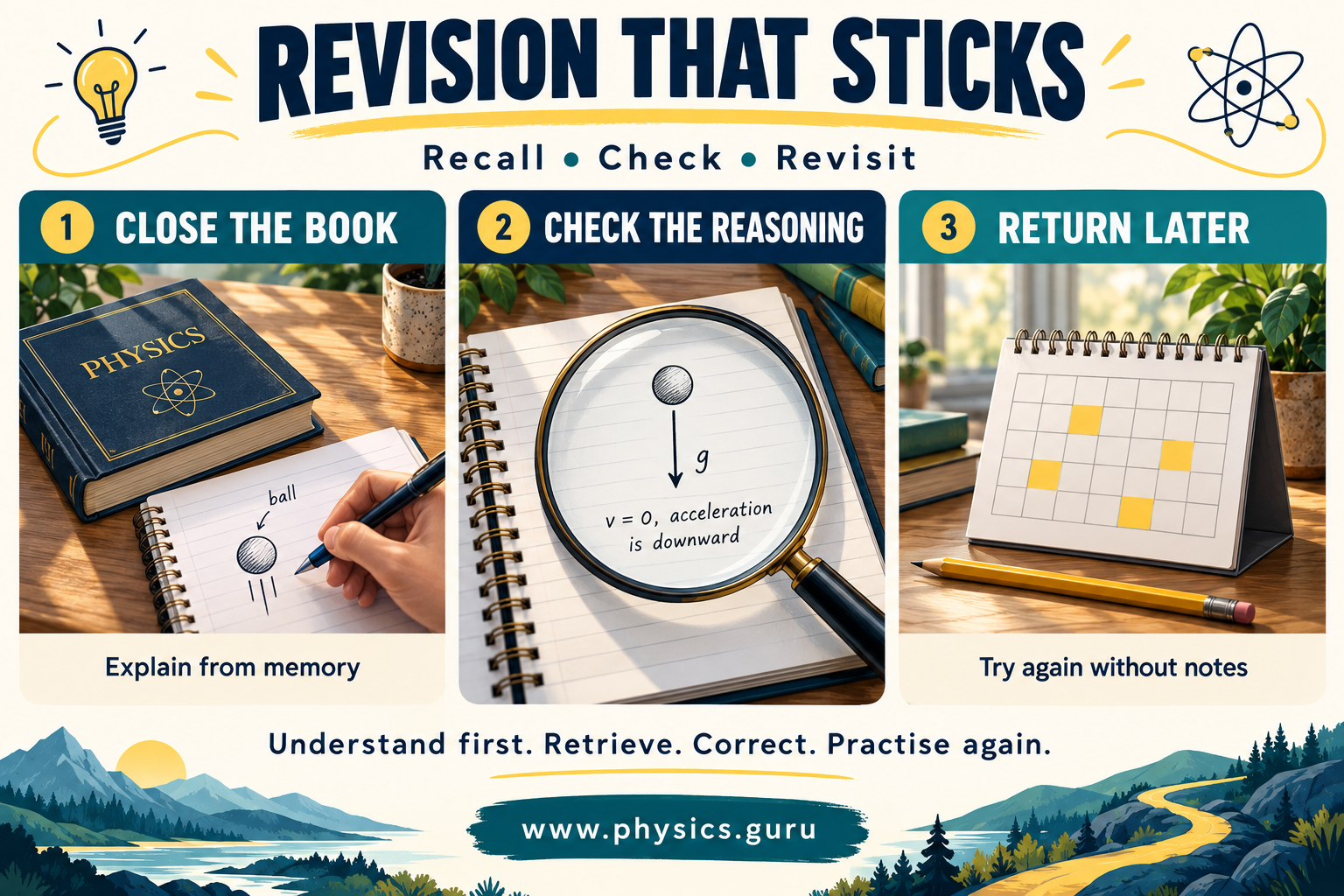
Build a practical Physics revision routine with closed-book recall, checked answers and spaced practice for Classes 9–12 and entrance-exam study.
Make revision show what you can explain
Reading a familiar Physics page can feel reassuring. The harder test comes when the page is closed: can you explain the idea, draw the situation and solve a fresh question? A useful revision session makes that gap visible while there is still time to fix it. The aim is not to recite an entire chapter perfectly. It is to discover which small pieces you can use independently.
Closed-book recall means attempting to retrieve an explanation or method before looking at it again. Spaced practice means returning to it across separate sessions. The Institute of Education Sciences practice guide supports spacing learning over time and using quizzes to revisit important content. The routine below is a practical adaptation for Physics study, not an official exam prescription or a guarantee of marks.
Start with one small learning target
Choose a target you can test: explain acceleration at the highest point of a vertical throw, distinguish mass from weight, or draw and interpret a particular circuit. “Revise mechanics” is too broad for one short session. Keep the relevant textbook or class notes nearby for checking, but close them before your first attempt.
If the idea has never been understood, begin with a clear explanation and a worked example. Recall practice should follow learning, not replace teaching. For a difficult topic, reduce the task to one diagram or one reasoning step rather than staring at a blank page for a long time.
Use a three-part recall prompt
On a blank sheet, answer three questions: What does the idea mean? Under what conditions does it apply? Can I use it in a short example? Write in your own words, and label every quantity in any equation you use. For a diagram-based topic, reconstruct the diagram rather than copying its outline.
Here is a self-created practice prompt, not a previous-year question: a ball is thrown vertically upward near Earth’s surface, with air resistance neglected. What are its velocity and acceleration at the highest point? At that instant its velocity is zero, but acceleration remains downward with magnitude g. If upward is positive, a = −g. Gravity has not switched off. OpenStax’s free-fall discussion and Example 3.15 explain this distinction.
Check the reasoning before repeating
Open the trusted explanation only after making a genuine attempt. Compare your reasoning, conditions, diagram, signs and units, not just the final answer. Mark the precise missing step. “I treated zero velocity as zero acceleration” is useful feedback; “I am bad at Physics” does not tell you what to practise.
Close the source again and explain the corrected idea in a fresh sentence. Then answer a slightly different question: immediately after the ball begins descending, what is the direction of its acceleration? If you can repeat the answer but cannot explain why, ask a teacher to help resolve the underlying misconception.
Return after a gap, then mix carefully
Put the target on a simple review list. For example, revisit it the next day, later that week and again in a later week. These are adjustable planning intervals, not a scientifically optimal timetable for every student. Shorten the gap when you struggle; extend it when you can explain and apply the idea reliably. Keep older topics in circulation while learning new ones.
At each return, try without notes first. Change the numbers, wording or representation so that remembering the previous answer is not enough. Once individual methods are reasonably secure, mix a few familiar question types and explain which method you selected. If mixing becomes overwhelming, return briefly to a worked example and a closely related independent problem.
Fit the routine to your level
For Classes 9–10, focus on clear definitions, simple diagrams, units and short explanations before adding numerical steps. In Classes 11–12, include assumptions, vector directions and links between representations. Students preparing for NEET, JEE Main, JEE Advanced or CUET can use the same routine with questions appropriate to their own course and current preparation level.
Do not confuse a correct option with a complete explanation. After a practice MCQ, state why the chosen option fits the situation and what error could produce one distractor. For written practice, show enough reasoning for another person to follow. A Class 12 pass-out can apply the routine to a narrow weak area without restarting every chapter.
Try a manageable session today
Allow about five minutes for closed-book recall, ten for one or two suitable questions, and five for checking and planning the next revisit. Adjust the time to the topic. Judge progress by what you can now explain or solve without help, rather than the number of pages reread. Parents can ask, “Which idea is clearer now?” instead of turning every review into a marks comparison.
Choose one topic today and bring the attempted solution, correction and remaining doubt to your next lesson. If you need help identifying the missing concept, use the course or enquiry options on www.physics.guru and mention your class, learning goal and the exact question that stopped you.