Trapped-Ion Quantum Gates: How Engineered Light Gradients Improve Control
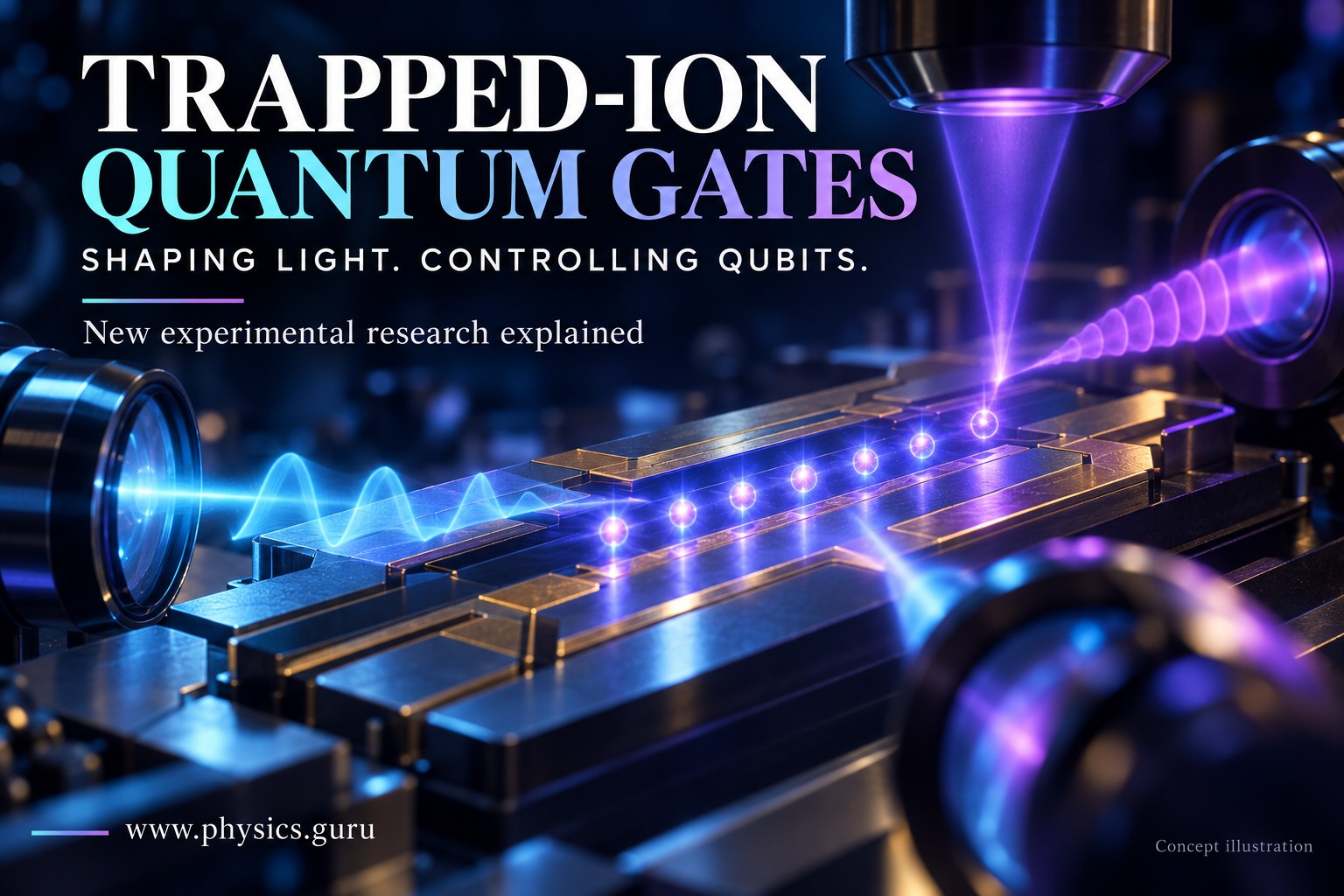
Conceptual editorial illustration, not an official document, photograph or measured scientific diagram.
Explore the 23 October 2026 trapped-ion study: engineered light gradients, two-qubit gate errors below 0.5%, and the physics behind the experiment.
A new experiment in controlling trapped ions
A paper published in Physical Review Letters on 23 October 2026 reports an experimental approach to entangling trapped-ion qubits with engineered light gradients. Tommaso Faorlin and colleagues, including researchers at Innsbruck and partner institutions, report two-qubit gates with error rates below 5 × 10⁻³ in ion crystals containing up to 12 ions.
That number is below 0.5%. It describes the reported two-qubit gate performance, not the success rate of a complete quantum computer. Likewise, a crystal containing 12 ions is not a claim that one gate simultaneously entangled all 12. Keeping the operation and the experimental system distinct is essential to reading this result accurately.
Why crowding becomes a control problem
The authors identify spectral crowding of collective motional modes as a limitation: an intended interaction can also couple to unwanted modes. Their method uses a time-dependent structured-light force transverse to the light’s propagation direction, reducing this unwanted coupling while retaining the ability to address individual ions.
For a classroom analogy, imagine trying to excite one vibration when several allowed vibrations have nearby frequencies. The analogy illustrates selective control; it is not a literal model of the quantum experiment. In a real device, the interaction must be designed and measured carefully enough to distinguish desired dynamics from unwanted responses.
What does a gradient mean in Physics?
A gradient describes how a quantity changes with position. A light field can vary across space, so knowing its value at one point does not tell you everything about its spatial pattern. This is a useful link to familiar school ideas: electric potential changes from place to place, and a slope carries information that the value alone does not.
As a general mathematical exercise, compare a constant function with one that changes rapidly over a short distance. They may have the same value at one chosen point but different derivatives there. This helps explain why shaping a field can offer an additional control variable beyond simply increasing its overall strength. It does not replace the quantum description used in the paper.
Reading the percentage without exaggeration
Convert the scientific notation carefully: 5 × 10⁻³ equals 0.005, and multiplying by 100 gives 0.5%. The phrase ‘below’ matters. It should not be rewritten as an exactly measured universal error probability for every operation or every device.
A useful practice question is to explain why a component-level error number cannot, by itself, specify the reliability of an entire calculation. A complete computation involves many operations, preparation and measurement. Without information about the sequence and how errors behave, one cannot infer its final accuracy from a single headline statistic. This is a reasoning exercise, not an additional result of the experiment.
Why this is interesting for Physics students
The study provides a bridge between waves, oscillations, fields and quantum information. Students preparing for CBSE, NEET or JEE can use it to practise identifying familiar ideas inside unfamiliar research. Start with the physical system, then identify the control applied, the response observed and the quantity used to judge performance.
Keep a two-column reading note: ‘reported observation’ and ‘my explanation or analogy’. This prevents a helpful mental picture from becoming an unsupported scientific claim. You do not need to master every mathematical step in an advanced paper to learn how a controlled experiment tests an idea.
What to take from the paper
The result concerns a particular experimental method for improving entangling control. It is not evidence of a finished, fault-tolerant general-purpose quantum computer. Read the original paper for the apparatus, measurements and limitations before comparing it with another platform.
The poster accompanying this article is a conceptual illustration, not a photograph, measured field map or engineering diagram. Use the journal source below for scientific details, and use the percentage-conversion and gradient exercises above to connect the news with your own Physics learning.