How to Choose the Right Equation for a Physics Numerical
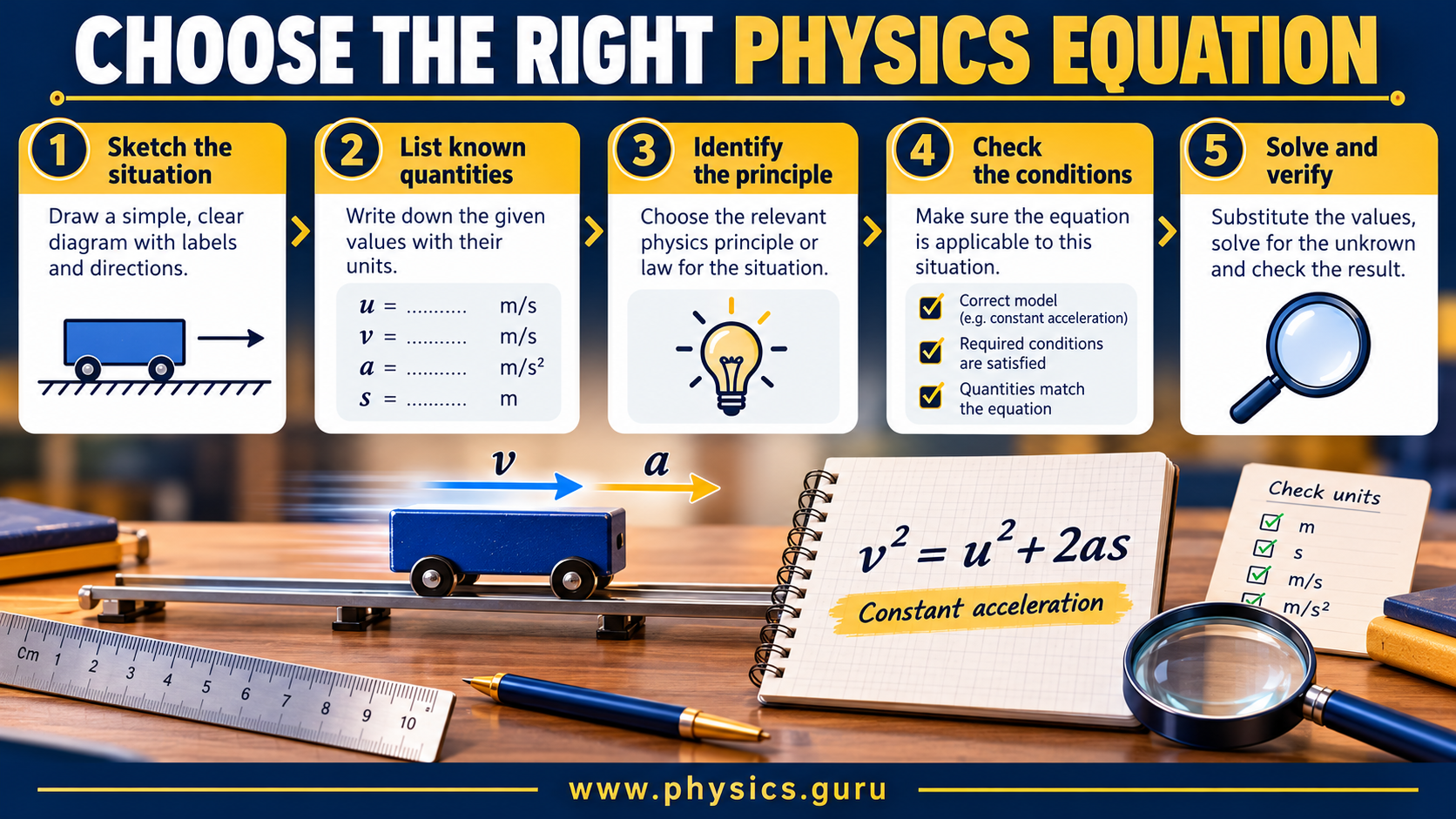
Learn a clear method to choose Physics equations, check assumptions and solve numericals with confidence, using a simple worked motion example.
Start with the situation
Knowing several formulas does not always tell you which one to use. A numerical becomes easier to organise when you identify the physical situation before substituting numbers. The following method is useful for students building foundations in Classes 9 and 10, and for Class 11 and 12 students practising CBSE, NEET, JEE or CUET Physics.
Begin by reading the question once without calculating. What object or system is being studied? What happens between the initial and final states? What must be found? Underline the requested quantity rather than every number. This keeps an unfamiliar-looking question from turning into a search through your entire formula sheet.
Sketch and name the quantities
Draw a small diagram, even if the question has no supplied figure. A box on a surface, a straight track or a simple circuit can make relationships visible. Label directions, starting and ending positions, and the quantities that matter. The sketch should explain your thinking, not become an elaborate drawing.
Next, list what is known and what is unknown, with units. Use symbols consistently. In straight-line motion, u commonly represents initial velocity, v final velocity, a acceleration, s displacement and t elapsed time. Remember that displacement includes direction; it is not always the total distance travelled. Convert compatible quantities into a consistent unit system before calculating.
Identify the principle and its conditions
Ask what connects the known information to the unknown. Are you describing motion, relating forces to acceleration, comparing energy changes, or analysing a circuit? Name the relevant principle in words. If you cannot explain why it applies, pause and revisit the concept instead of trying formulas at random.
Write one condition beside the proposed equation. For example, the familiar straight-line kinematic equations require constant acceleration over the interval being considered. A journey that includes accelerating, cruising and braking may need separate stages. A formula can be remembered correctly and still be unsuitable for the situation.
Choosing an equation only because it contains familiar letters is risky. Check what each symbol means, which object it describes and which time interval it covers. Different parts of a problem can use the same symbol for different values unless you label them carefully.
Choose the shortest valid route
After checking the model, prefer an equation that connects the required quantity to information already available. Avoid introducing an extra unknown unless there is a second independent relationship to determine it. This is a planning step, not a rule that every question must be solved in one line.
For constant acceleration along a straight line, v = u + at connects velocity and time. The relation v² = u² + 2as connects velocity and displacement without time. Here s is displacement measured from the initial position. Both require consistent signs. OpenStax’s Motion with Constant Acceleration section explains these conditions and relationships; the reference is provided below.
A short original practice example
A trolley starts from rest and accelerates uniformly at 2 m/s² along a straight track. Find its speed after a displacement of 9 m in the direction of acceleration. This is an original practice example, not a previous-year examination question.
Take the direction of motion as positive. The known values are u = 0, a = 2 m/s² and s = 9 m. The unknown is v; time is neither supplied nor required. Therefore choose v² = u² + 2as. Substitution gives v² = 0 + 2 × 2 × 9 = 36 m²/s², so the speed is 6 m/s. The motion described selects the positive velocity in our chosen direction.
The important learning is the choice: constant acceleration makes the equation valid, and the available quantities make it convenient. If the acceleration varied with time or position, this same substitution would not generally be justified.
Check before moving on
Check units, signs and physical meaning. Does an answer requested as speed have units of m/s? Does the result fit whether the object speeds up or slows down? A negative velocity may simply mean motion opposite to your positive direction; it is not automatically an error.
Unit checking can catch many mistakes, but matching dimensions does not prove an equation is correct. Also inspect your algebra and assumptions. If a result appears unreasonable, return to the model and sign convention before repeating the arithmetic.
Practise equation selection separately
For your next study session, choose three familiar questions. Spend the first few minutes writing only the sketch, known quantities, unknown, governing principle and equation conditions. Then solve them. Finally, explain why one tempting alternative equation would be less convenient or invalid.
Parents can ask, “What made you choose that equation?” rather than judging only the final answer. Students who repeatedly get stuck at this step can seek focused concept and numerical practice through Physics classes by Sunil Gola, available online and offline in Sector 85, Gurgaon, with one-to-one and small-group sessions. Visit www.physics.guru to enquire about the appropriate learning format.