Four Moon Sites Recommended for Future Human Exploration
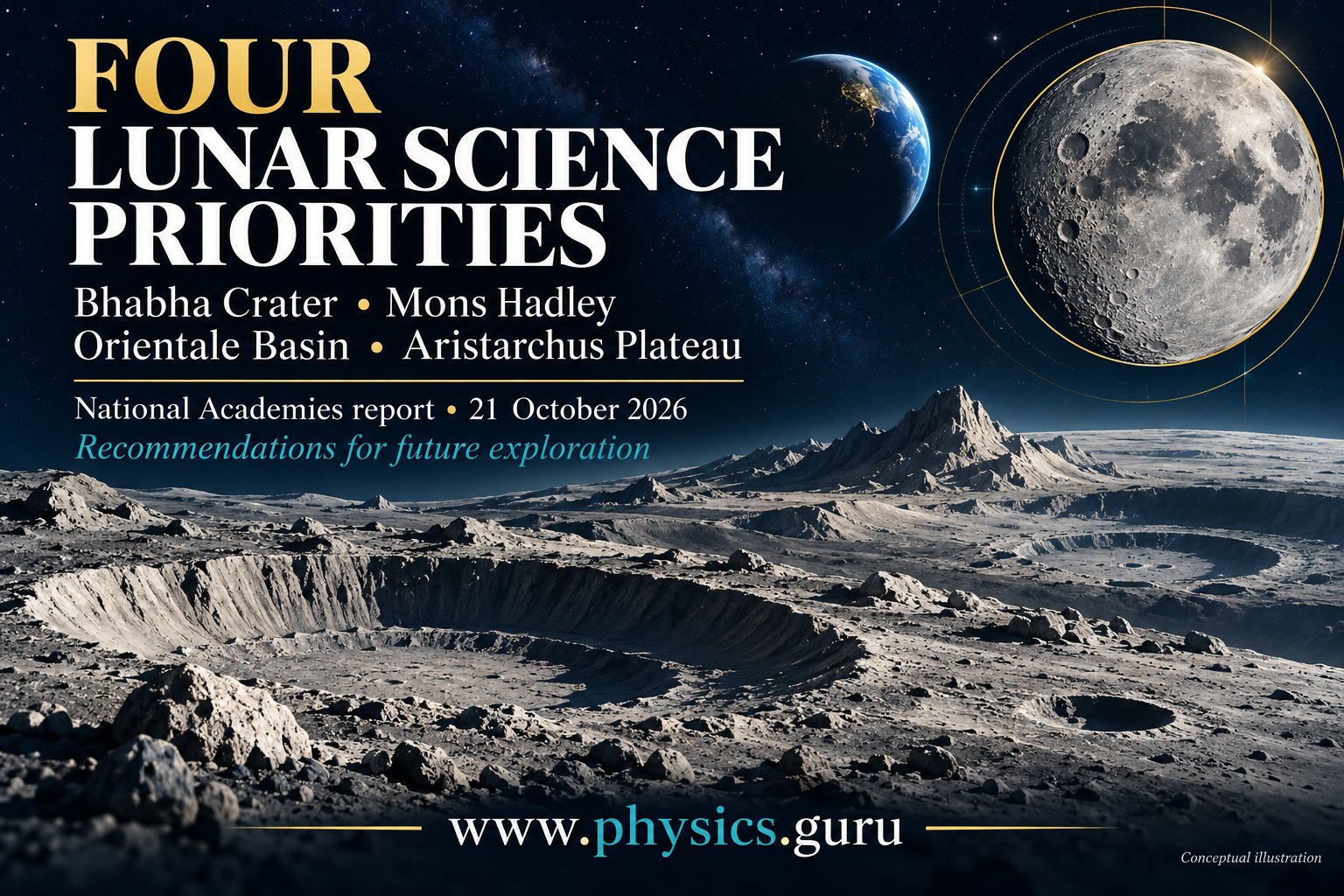
Conceptual lunar artwork; it is not a location map, mission photograph or announcement of a scheduled landing.
A 21 October 2026 National Academies report recommends four lunar sites. Learn their scientific value and why these are recommendations, not booked missions.
A scientific shortlist for future exploration
A National Academies announcement dated 21st October, 2026 identifies four priorities for future human exploration of the Moon: Bhabha Crater, Mons Hadley, Orientale Basin and Aristarchus Plateau. The report, Human Exploration Across the Moon, considers destinations beyond the lunar polar regions. Its purpose is to guide scientific choices; it is not a declaration that astronauts have landed at these sites or that four missions have been scheduled.
What makes the four destinations interesting?
Bhabha Crater offers access to far-side crust and ancient impact-basin material, with opportunities for astronomy. Mons Hadley, near the Apollo 15 landing area, could support geological sampling and study of materials exposed to the lunar environment for decades. Orientale Basin's multi-ring impact structure offers clues to lunar history and interior processes. Aristarchus Plateau provides a volcanic landscape for investigating past activity and potentially useful resources.
Together, the destinations represent different scientific questions rather than four interchangeable places to plant a flag. Their value depends on the observations, instruments and samples a mission could obtain.
Why the Moon is a useful natural laboratory
A distant landscape becomes scientifically valuable when it can answer a well-defined question. Samples can preserve information about formation and later change; instruments can measure present conditions; repeated observations can reveal variation over time. The challenge is to connect each proposed activity with evidence that would distinguish between competing explanations.
For example, collecting an unfamiliar rock is only the beginning. Researchers need to know where it was found, how it relates to the surrounding geology and how handling might affect subsequent measurements. Planning those observations before a mission helps make limited astronaut time more productive.
What must happen before a recommendation becomes a mission?
Scientific priority is one part of mission planning. Engineers must also consider landing safety, power, communications, mobility, equipment reliability and the protection of the crew. A destination with compelling science still needs a practical way to reach and study it.
Recommendations can inform those decisions, but they do not by themselves establish a launch date, budget approval, crew assignment or final landing location. Readers should therefore look for a separate mission-authority announcement before treating a recommended site as an approved destination. This distinction also prevents a report about possible future experiments from becoming a misleading headline about discoveries already made.
A classroom connection: energy, waves and measurement
For Physics students, lunar exploration provides a setting in which familiar ideas become engineering problems. Solar energy must be converted and stored, radio waves must carry information, and instruments must maintain useful measurements despite environmental change. Each task involves constraints as well as opportunities.
Try framing a mission idea as three questions: What quantity will we measure? Which instrument can measure it? What uncertainty or interference could make the result unreliable? This exercise is more valuable than memorising a list of destinations because it follows the logic of experimental science.
Students can also compare two possible sites using the same scientific objective. The best choice depends on the question and the limitations of the mission; there is no universal location that is automatically ideal for every experiment.
Quick answers about the report
Has NASA confirmed four new crewed landings? That claim is not established by this report. Are the sites all near the South Pole? The study addresses nonpolar destinations. What should readers watch for next? Formal mission decisions, updated engineering plans and specific instrument or sample objectives will show how scientific advice translates into an executable programme.