Could a Heavy Neutrino Help Explain Why Matter Survived?
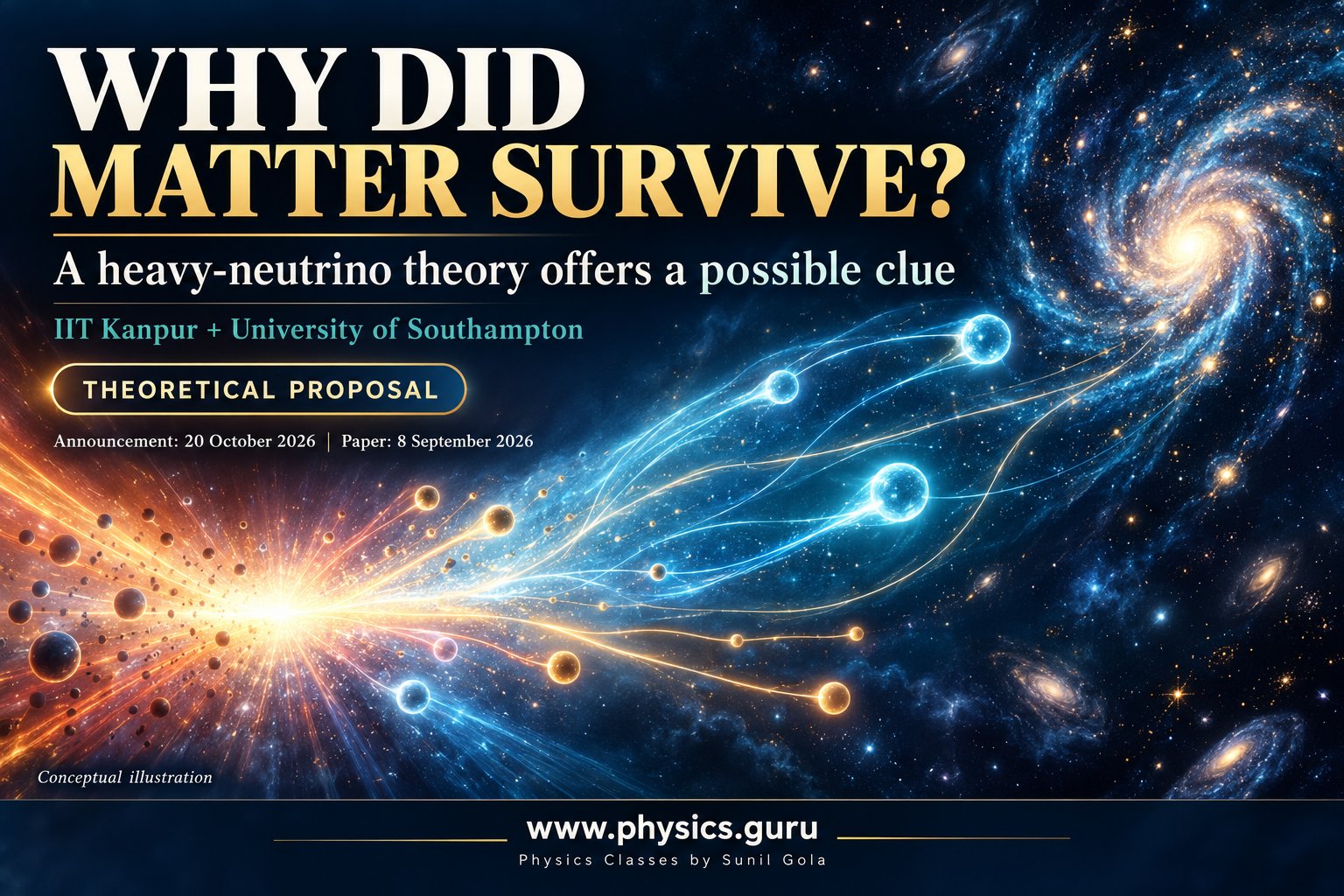
IIT Kanpur and Southampton researchers explore how a long-lived heavy neutrino could affect the early universe. Understand the theory and its limits.
A new announcement about an earlier research paper
A University of Southampton announcement dated 20 October 2026 highlights work by Rishav Roshan and Sudipta Show, affiliated with Southampton and IIT Kanpur respectively. Their paper, “Delayed Charged Lepton Yukawa Equilibration in Minimal Seesaw”, appeared in Physical Review Letters on 8 September 2026. The announcement is new; the journal publication is earlier.
What question are the researchers exploring?
The universe contains abundant matter, including the atoms in stars, planets and our bodies. Explaining the matter–antimatter imbalance is a major question in cosmology and particle physics. The researchers investigate whether a heavy, weakly interacting neutrino included in their theoretical framework could play a larger cosmological role than is usually assigned to it.
How a weakly interacting particle could still matter
In the proposed scenario, the particle lives long enough to change the early universe’s expansion history and the temperature at which certain interactions come into equilibrium. That change affects calculations of lepton-flavour effects in thermal leptogenesis, a theoretical route associated with generating the matter–antimatter imbalance. A small direct interaction does not automatically imply an unimportant collective effect over cosmic time.
What has—and has not—been established?
This work presents a theoretical mechanism. It does not report detection of the proposed heavy neutrino or a completed experimental explanation of why matter survived. The paper identifies neutrino oscillation measurements and gravitational-wave observations as possible ways to investigate the scenario. These are prospective tests, not reported confirmations.
A useful connection for school Physics students
One valuable habit in Physics is to ask which time scale controls a process. A familiar example is whether a measurement lasts long enough to reveal a slow change. Early-universe calculations use much more advanced mathematics, but the same habit of comparing processes and time scales remains useful. This classroom comparison is a learning aid, not a model of neutrino physics.
How to read the research headline carefully
Separate the ingredients of the argument: the assumed particle, its calculated influence on expansion and interactions, and the observations that might test the consequences. A successful calculation can make a proposal worth investigating without establishing that nature follows it. That distinction helps students appreciate scientific progress without turning a promising hypothesis into a discovery claim.
Why this is interesting beyond the headline
A theoretical model contains assumptions about which particles exist and how they interact. Researchers can explore what follows mathematically, then ask whether the predicted consequences are compatible with observations. Changing an assumption that was previously treated as unimportant can alter the model’s conclusions. That is why the distinction between a particle’s direct interactions and its influence on the surrounding universe matters in this discussion.
A three-column reading method for students
When reading a research report, make three columns: assumptions, calculated consequences and observational evidence. Place the proposed long-lived heavy neutrino in the first column, its modelled cosmological effects in the second, and any actual measurements used to test those effects in the third. Do not move a claim from one column to another because a headline sounds confident. This simple exercise develops the habit of evaluating what a study really establishes.
A classroom discussion prompt
Ask: “What would make this explanation more convincing?” A useful answer should mention a prediction that could be checked and consider whether other explanations could produce a similar observation. Students need not master the advanced equations to recognise these standards of reasoning. For CBSE, JEE and NEET learners, the immediate educational value is careful interpretation: distinguish a hypothesis, a calculation and a measurement before deciding what conclusion is justified.