One Year Inside NASA’s Simulated Mars Habitat: What CHAPEA Can Teach Us
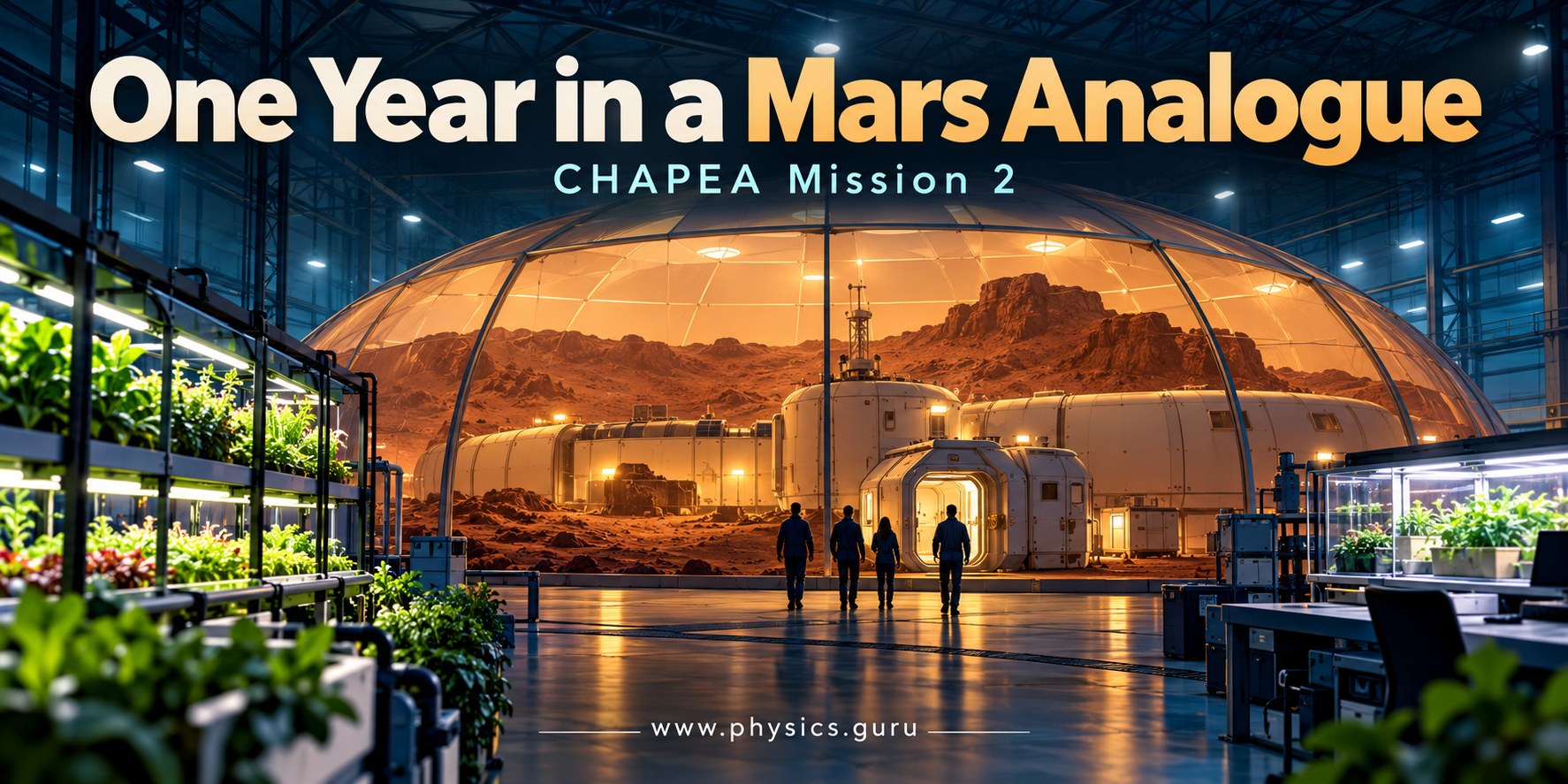
Conceptual editorial illustration; not a photograph of the actual people, campus or experiment.
NASA’s CHAPEA Mission 2 marked one year on 19 October 2026. Explore what an Earth-based Mars analogue studies and what its results can establish.
What students and parents should know
On 19 October 2026, NASA reported that the four members of CHAPEA Mission 2 had spent a year living and working inside a simulated Mars habitat at Johnson Space Center in Houston. The milestone concerns an Earth-based research mission designed to study aspects of living under Mars-like operational constraints.
NASA says the crew entered the habitat on 19 October 2025 and is scheduled to leave on 31 October 2026. Post-mission evaluations and debriefs are planned after exit. The anniversary is therefore a progress milestone, with further scientific analysis still ahead.
Why simulate a mission on Earth?
Space exploration is a systems problem. A mission involves equipment, food, work schedules, maintenance, communication and people making decisions together. A terrestrial analogue allows researchers to study selected aspects of that system before exposing a crew to the full difficulty of a distant destination.
The power of an analogue comes from a clearly defined question. Researchers can introduce particular constraints and observe how people respond. Its limits matter just as much: a habitat on Earth cannot reproduce every feature of Mars, including the planet’s gravity or the full space-radiation environment.
What the crew has been doing
NASA describes activities including crop growing, managing limited resources, operating with communication delays and carrying out simulated surface activities. The mission gathers health and performance information that can inform planning for future long-duration exploration.
These activities belong together. Food production requires time and attention, maintenance competes with scientific work, and delayed communication changes how problems can be discussed with support teams. Studying the combined daily routine can reveal issues that are less visible when each task is considered in isolation.
The Physics of delayed communication
Electromagnetic signals travel at a finite speed. As a general Physics relationship, a signal’s one-way travel time is approximately the distance divided by the speed of light. Longer distances therefore create longer delays, even before considering the time needed to read a message, investigate a problem and prepare a response.
For a distant crew, this changes the meaning of support. A conversation cannot always proceed like a live telephone call. Instructions must be clear, information must be organised, and some decisions must be made locally. The exact communication constraints in an analogue are part of its experimental design; they should not be confused with one fixed travel time that applies to Mars at all dates.
Why a year is more than a long demonstration
A short exercise can reveal whether a procedure is workable on a particular day. A longer mission can explore how routines interact with changing workload and prolonged confinement. However, duration alone does not establish a conclusion. Researchers still need appropriate measurements, careful analysis and consideration of the study’s design.
NASA’s report describes preparations to process health and performance data and the evaluations planned after the crew exits. It would be premature to turn the anniversary into a claim that every challenge of a human Mars mission has been solved. A small analogue crew provides one source of evidence within a much larger research effort.
A useful classroom exercise
Students can explore delayed communication with a simple planning activity. One group describes a model-building task in a written message; another group must wait before replying. Compare the clarity of messages with an ordinary real-time discussion. This is an educational exercise about communication, not a replication of NASA’s experiment or a test of astronaut suitability.
For Physics learners, the story connects waves and signal speed with engineering and human decision-making. For parents, it offers a concrete example of careers that combine science, medicine, computing and teamwork.