Can Light Organise Electrons? A New Theoretical Route to Controlling Quantum Materials
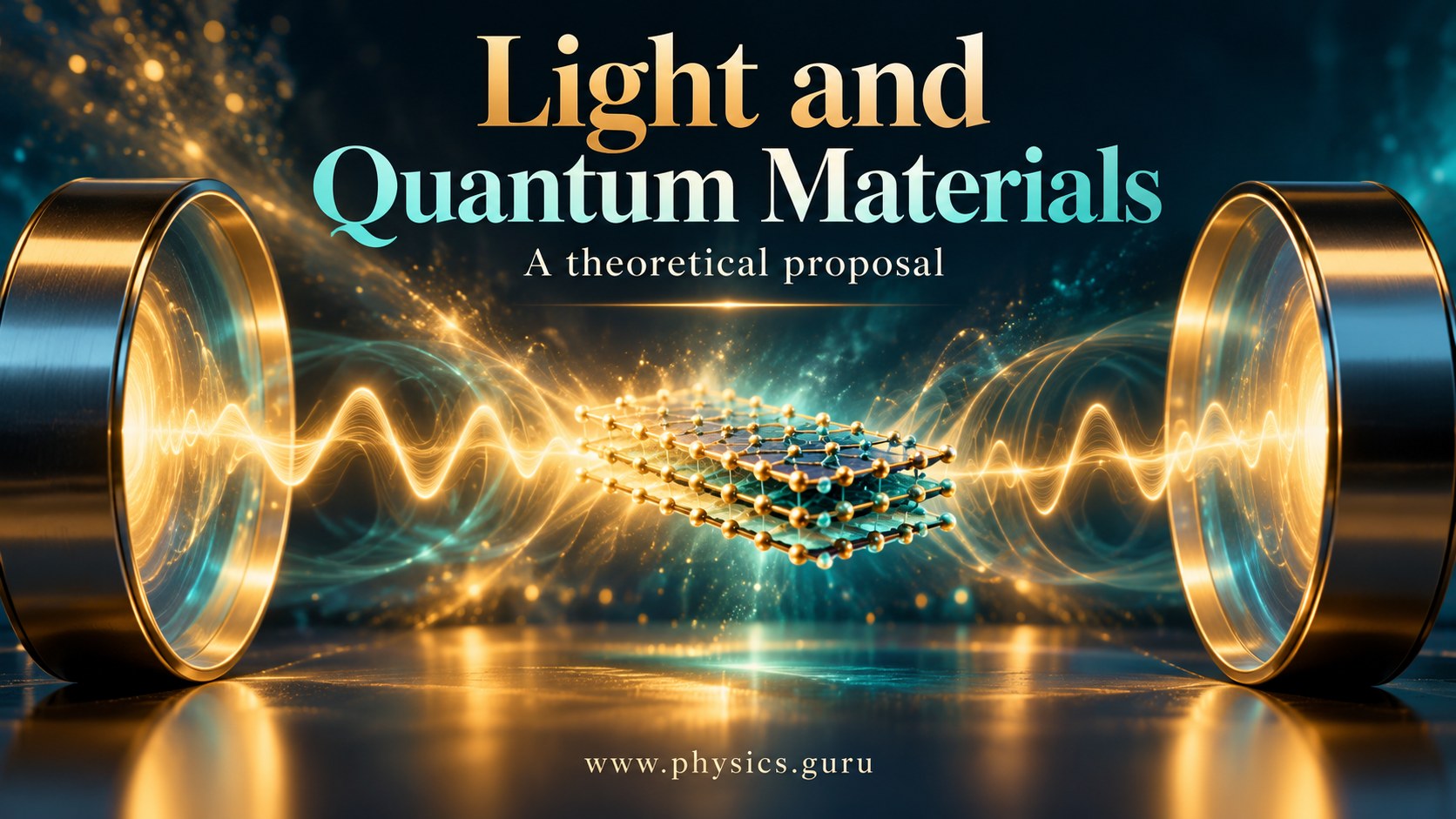
Conceptual editorial illustration; not a photograph of the actual people, campus or experiment.
A Nature Communications theory paper proposes using an optical cavity and nanoscale grating to control electronic order. Learn the physics and limits.
What students and parents should know
Can light do more than illuminate a material—can it help organise the behaviour of electrons inside it? A theoretical study published in Nature Communications on 19 October 2026 proposes a way to investigate that possibility using a driven material, an optical cavity and a nanoscale grating.
The paper, “Superradiant charge density waves in a driven hybrid cavity-matter system,” presents a proposed platform and calculations. It does not report an experimental demonstration of the proposed device. Its interest lies in the physical mechanism it identifies and the conditions it calculates for collective electronic ordering.
What is electronic order?
A solid contains many interacting particles. Its behaviour is not always understood by imagining each electron acting independently. Under appropriate conditions, collective patterns can develop. A charge density wave refers to a spatial modulation in electronic charge density: some regions have relatively more electronic charge than others in an organised pattern.
This is different from a photograph of individual electrons arranged as visible beads. Scientific illustrations often use repeating bright spots to make a pattern understandable, but the underlying description involves a density and its spatial variation. An illustration should help readers picture the idea without being mistaken for measured microscopy data.
Why use an optical cavity?
An optical cavity supports particular electromagnetic modes. A familiar conceptual picture is light interacting repeatedly with a region between reflecting boundaries. Cavities can strengthen or reshape light–matter interactions, making them useful settings for studying collective effects.
Classroom standing waves provide a useful starting point. Boundary conditions select allowed patterns, and resonance affects the response. Real optical cavities require a more detailed treatment of geometry, losses and coupling, but the connection to wave physics helps explain why the surrounding electromagnetic environment can matter to a material.
The challenge addressed by the proposal
The authors consider driven, doped transition-metal dichalcogenides coupled to an optical cavity. Their proposed nanoscale grating supplies large in-plane optical momenta, addressing a mismatch between optical wavelengths and relevant electronic length scales. The coupling mechanism involves exciton-polaron processes.
Using a stability calculation, they identify thresholds for the proposed ordering and map a driven phase diagram. Their analysis indicates that matching the grating periodicity to enhanced electronic density fluctuations can reduce the required pumping intensity. These are results within the theoretical model and proposed operating conditions.
How to understand a threshold calculation
In many physical models, a state responds weakly to small disturbances until a control parameter crosses a threshold. A stability analysis asks whether those disturbances decay or grow. That mathematical question can identify where a new organised state may become possible.
A simple analogy is a balanced object: a tiny displacement may be corrected by restoring forces or amplified into a fall. The quantum-material problem is much richer, but the underlying question—does a perturbation shrink or grow?—offers an accessible route into the meaning of stability.
What remains to be tested
A theoretical route guides experimental questions. Researchers would need to build an appropriate system, control its parameters and distinguish the predicted ordering from competing explanations in measurements. Agreement between model and experiment would require evidence, not simply the presence of a cavity and a grating.
Readers should therefore avoid turning this work into a claim of a finished optical switch, a commercial product or a demonstrated new superconductor. The reported contribution is a proposed mechanism and its analysis. That is valuable scientific work in its own right.
A learning path from school Physics
Begin with interference, standing waves, resonance and the relationship between wavelength and momentum. Next study how periodic structures interact with waves. At a more advanced level, solid-state physics explains collective electronic behaviour. Connecting these topics shows how familiar equations become building blocks for current research.