Nobel Physics 2026: Francis Halzen, IceCube and Cosmic Neutrinos
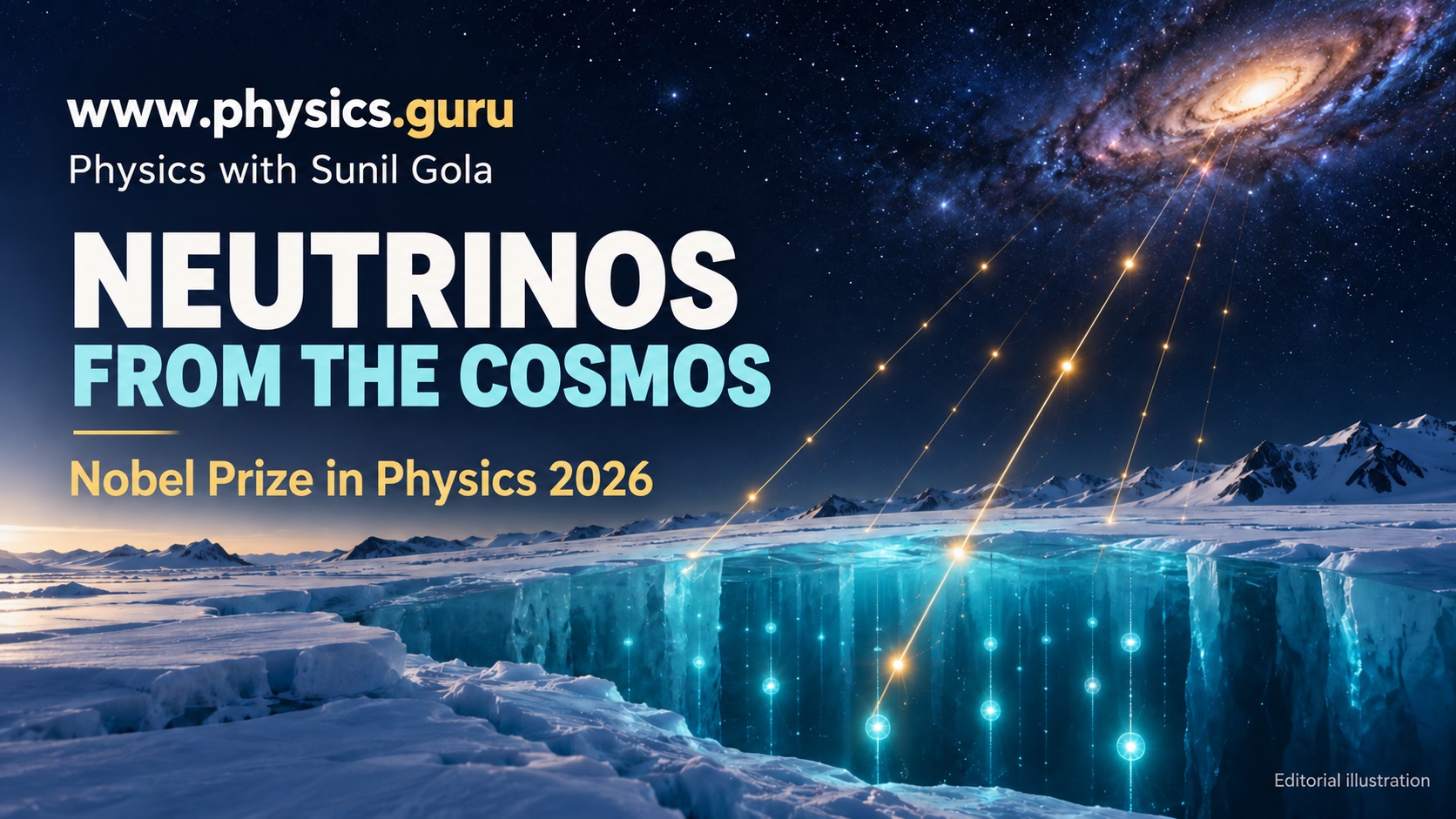
Discover why Francis Halzen received the 2026 Physics Nobel and how IceCube uses Antarctic ice to study cosmic neutrinos, explained for students.
A new way to study the universe
The 2026 Nobel Prize in Physics was awarded to Francis Halzen on 6 October for his contributions to the IceCube Neutrino Observatory and the discovery of high-energy neutrinos from astrophysical sources. IceCube, the US National Science Foundation and Fermilab have published official accounts of the award.
The story begins with a striking idea: a huge volume of Antarctic ice can serve as part of an astronomical instrument. Instead of gathering light through a conventional telescope, the observatory looks for evidence of rare particle interactions deep below the South Pole.
What is a neutrino?
A neutrino is an elementary particle with no electric charge. Neutrinos interact very weakly with ordinary matter, so enormous numbers can pass through objects without leaving a detectable signal. That makes them difficult to observe, but also makes them useful messengers from environments that are hard to study in other ways.
Because neutrinos are electrically neutral, magnetic fields do not deflect them in the way they deflect charged cosmic-ray particles. Measurements of high-energy neutrinos can therefore help researchers investigate energetic processes in the universe. The particle and the light used to detect it are different things: neutrinos are not a form of electromagnetic radiation.
How ice becomes part of a detector
IceCube instruments roughly a cubic kilometre of deep glacial ice with light-sensitive detectors. Most neutrinos pass through without an interaction. Occasionally, a neutrino interacts and produces secondary charged particles. Those particles can generate light that the sensors record.
The detector therefore does not take an ordinary photograph of an incoming neutrino. Scientists reconstruct information from the light pattern, its timing and the amount detected. IceCube’s educational explanation describes how these measurements help estimate the original particle’s energy and direction.
This is an important scientific habit: distinguish the thing of interest from the signal actually measured. A thermometer measures a physical response linked to temperature; IceCube measures light linked to a particle interaction. In both cases, a model connects the instrument’s reading to the quantity being investigated.
Why the instrument must be so large
Rare events require enough opportunities to observe them. Halzen’s proposal used the clear South Pole ice as an enormous detection medium, with sensors placed far below the surface. The NSF account describes the technical ambition of deploying thousands of detectors more than two kilometres deep.
A classroom analogy is catching occasional raindrops with containers. A larger collecting area usually catches more drops over the same interval. IceCube is not a rain collector, and its actual detection process is more complicated, but the analogy helps explain why a tiny target would miss too many rare interactions.
The Nobel recognises leadership within a large collaboration
IceCube’s official announcement highlights Halzen’s scientific vision and leadership while recognising the international collaboration behind the observatory. Major discoveries depend on researchers, engineers, technicians, computing specialists and operational teams working across many institutions.
The collaboration reported astrophysical neutrinos in 2013 and later presented evidence associated with distant galaxies. It also announced neutrino observations from the Milky Way in 2023. These are milestones in a developing field, rather than a claim that every cosmic neutrino source has now been identified.
Three connections to school and entrance-exam Physics
First, revisit electric charge and magnetic forces. Explain why a charged particle’s motion can be influenced by a magnetic field, then identify why a neutral particle requires a different discussion. Be careful not to conclude that “no charge” means “no interaction of any kind”.
Second, practise units and scale. Sketch a cube with sides of one kilometre and calculate its volume in cubic metres. The result is one billion cubic metres. This is a scale exercise, not an exact drawing of IceCube’s geometry.
Third, think about signal and background. If an instrument records many events, how would you decide which ones support the scientific claim? List possible questions about timing, direction, calibration and uncertainty. These questions matter even when the full mathematics lies beyond the school syllabus.
Keep curiosity connected to careful study
News about a Nobel Prize can turn an abstract chapter into a real scientific question. Use it to practise explaining a mechanism, following units and separating observations from interpretations. You do not need to master advanced particle physics to begin thinking clearly about how evidence is collected.
For structured Physics learning, www.physics.guru offers Classes 9–12 Physics and preparation for JEE, NEET and CUET with Sunil Gola, a DTU alumnus with 18 years of teaching experience. Classroom sessions are available in Sector 85, Gurugram, alongside live interactive online classes. Call 8800880028 to discuss the student’s learning needs.