Nobel Chemistry 2026: Kagan, Soai and the Science of Molecular Handedness
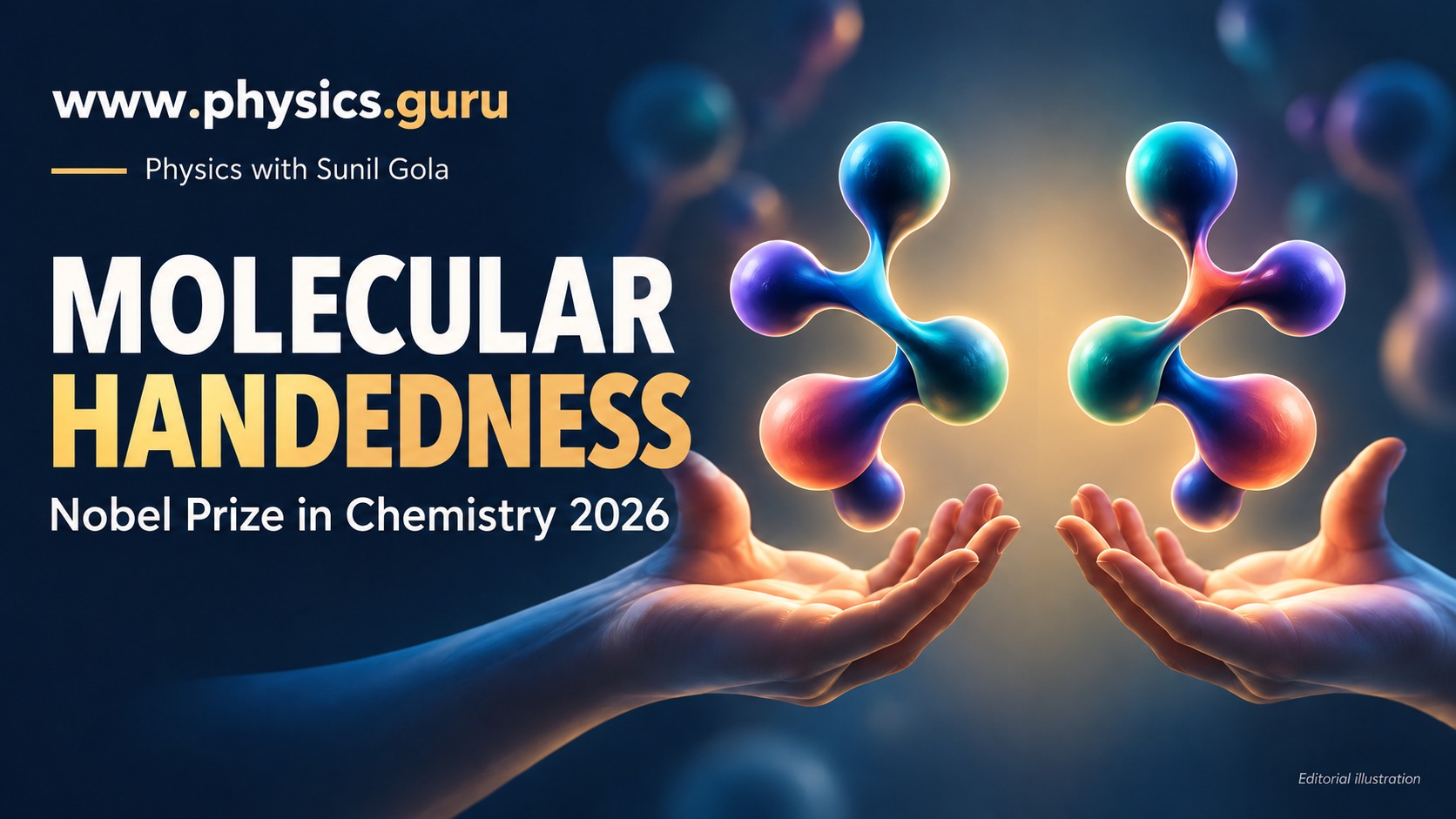
Understand the 2026 Chemistry Nobel for Kagan and Soai through chirality, non-linear effects and autocatalysis, with simple student exercises.
What the 2026 Chemistry Nobel recognises
Henri B. Kagan and Kenso Soai were awarded the 2026 Nobel Prize in Chemistry, announced on 7 October, for discoveries involving non-linear effects and autocatalysis in asymmetric organic synthesis. The Royal Swedish Academy of Sciences identifies their work as a major advance in understanding how reactions can favour one molecular mirror image.
The vocabulary may sound advanced, but the underlying questions are accessible: can two molecules have the same composition yet behave differently because of their arrangement in space? Can a small initial imbalance become much larger during a reaction?
Start with your hands
Hold your hands with both palms facing upwards. They resemble mirror images, yet rotating one hand does not make every feature coincide with the other while keeping the same orientation. This offers a familiar way to approach chirality, or handedness.
Some molecules likewise exist as non-superimposable mirror-image forms, called enantiomers. Their atoms are connected in the same way, but their three-dimensional arrangements differ. Not every molecule is chiral, so the presence of atoms and bonds alone is insufficient to establish handedness.
This distinction matters in biological chemistry because molecular interactions depend on three-dimensional structure. Different enantiomers can interact differently with biological targets. That does not mean one member of every pair is beneficial and the other harmful; the outcome must be investigated for the particular substance and application.
What Kagan showed about non-linear effects
In an asymmetric reaction, the objective is to favour one enantiomer over the other. Kagan investigated how the balance of mirror-image forms in a catalyst relates to the balance found in the product. His work showed that this relationship need not follow a simple proportional rule.
The Academy describes his 1986 discoveries as a way to obtain a stronger excess of one mirror-image product than had been assumed possible. The word “non-linear” here refers to the relationship between quantities in the catalytic system; it does not merely mean that a molecule has a bent shape.
What Soai added: a product that helps make more product
Tokyo University of Science explains that Soai developed asymmetric autocatalysis: the reaction product itself acts as a catalyst promoting the same reaction. Under suitable conditions, a small preference for one mirror-image form can be amplified as the reaction proceeds.
Think of the idea as chemical feedback, while remembering that the actual reaction follows specific molecular mechanisms. A product is formed, that product helps further formation, and an initially small imbalance can grow. Autocatalysis alone does not guarantee a single handed outcome; the reaction’s structure and conditions matter.
An original numbers exercise: excess is not the same as purity
Imagine a sample containing 60 molecules of one enantiomer and 40 of the other. The major form represents 60% of the total. The enantiomeric excess is the difference between the two percentages: 20%. These are two different descriptions of the same mixture.
Now try 90 of one form and 10 of the other. The major-form proportion is 90%, while the enantiomeric excess is 80%. For 50 and 50, the excess is zero. These are hypothetical counting exercises, not results from Kagan’s or Soai’s experiments. They help students read descriptions of asymmetric reactions without confusing the terminology.
Why the discovery matters—and what it does not prove
The Academy’s background explains that non-linear effects provide information useful for understanding and improving catalytic reactions. The research matters for chemists working on substances whose biological interactions depend on handedness, including pharmaceuticals and other specialised products.
The Soai reaction also offers a laboratory example of how strongly asymmetric outcomes can emerge. However, the Academy explicitly distinguishes its artificial chemistry from the chemistry of life. Demonstrating a possible amplification principle does not establish that this exact reaction occurred on early Earth. The origin of biological handedness remains a broader research question.
How students can use the story
Build a small model of a tetrahedral centre with four different coloured attachments, then construct its mirror image. Try rotating the models to test whether they superimpose. Next, write one sentence each defining chirality, enantiomer, catalyst and autocatalysis. Keep the molecular model separate from a reaction-rate explanation.
For a final exercise, sketch a straight-line relationship and a curved relationship between two labelled variables. Explain why “doubling the input doubles the output” is a particular assumption that needs testing. Connecting spatial reasoning, graphs and experimental evidence makes this news useful beyond memorising the laureates’ names.
Strengthen the Physics foundations of science learning
For structured Physics learning, www.physics.guru offers Classes 9–12 Physics and preparation for JEE, NEET and CUET with Sunil Gola, a DTU alumnus with 18 years of teaching experience. Classroom sessions are available in Sector 85, Gurugram, alongside live interactive online classes. Call 8800880028 to discuss the student’s learning needs.