DTU Mega Open House on 28 October 2026: A Student’s Preparation Guide
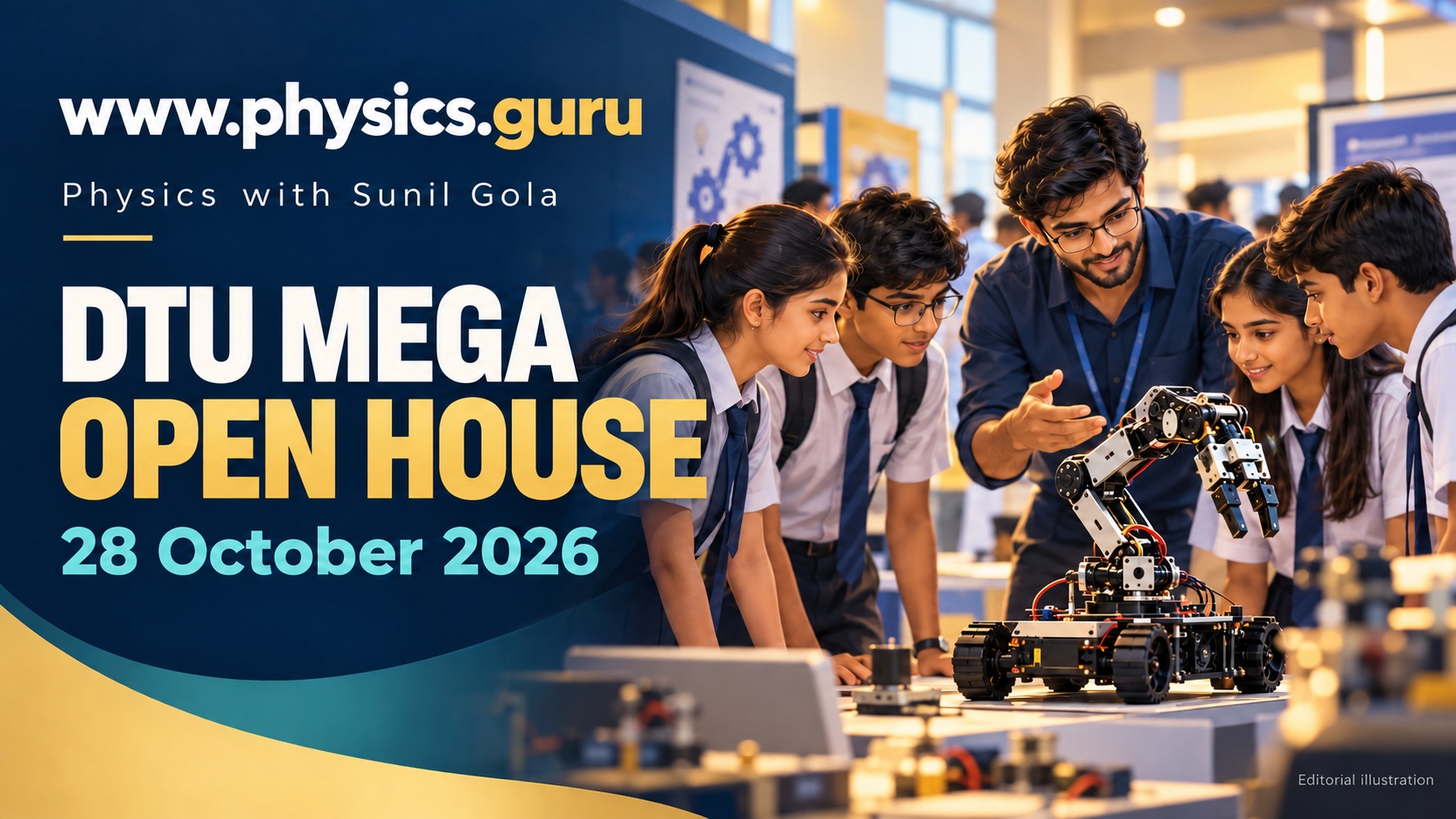
DTU announces its Mega Open House for 28 October 2026. Explore practical questions, visit preparation and ways to connect engineering with school Physics.
The confirmed event details
Delhi Technological University has announced a Mega Open House programme for Wednesday, 28 October 2026, from 10 AM to 4 PM. The announcement appears on DTU’s official website with a publication date of 12 October. This article checks that announcement as of 17 October 2026.
Before making a visit plan, open the Notice and Advertisement linked beside the announcement on DTU’s website. Confirm registration, eligibility, reporting arrangements and any instructions for accompanying adults directly from those documents or the organisers. The preparation ideas below are editorial suggestions; they are not a promised programme of DTU activities.
Go with questions that matter to you
A university event becomes more useful when a student arrives with a small set of questions. Choose two areas that interest you and one area you know little about. Someone who enjoys electricity might want to understand how electrical engineering differs from electronics, while a student who likes mechanics could explore the work involved in designing and testing a machine.
Write questions that invite explanation: What problem does this project solve? Which school concepts helped the team get started? What was difficult to measure? How did the design change after testing? These questions encourage a conversation about engineering work rather than a quick exchange of branch names and salary expectations.
Look for the connection between a model and evidence
If demonstrations or student projects are available, ask permission before handling equipment or taking photographs. Try to identify the input, the output and the measurement connecting them. A moving mechanism, for example, offers questions about force, torque, friction and power. A sensor invites questions about calibration, noise and the difference between a reading and the quantity being measured.
You do not need to understand every technical term. Choose one unfamiliar idea, ask for an example and record it for later study. A useful visit can end with three well-understood concepts rather than twenty photographs of equipment whose purpose you cannot explain. Curiosity is more productive than pretending to know an answer.
Ask about the everyday experience of learning
When an appropriate opportunity arises, ask current students how they balance lectures, laboratory work, assignments and independent study. Ask what they found difficult in the transition from school and what preparation actually helped them. Their experiences can offer perspective, but they are individual accounts rather than rules or guarantees for every student.
Parents may find it useful to separate academic questions from practical ones. Make different notes for programme structure, travel, accommodation and costs. For eligibility, fees, hostel policies or admissions, seek the relevant official publication. An informal conversation at an event can point you towards a document; it should not replace the document.
Plan the visit without creating a rushed day
After confirming participation arrangements, work out the journey, reporting location and a realistic return time. Carry the identification or confirmation that the organisers specify. For a school group, agree on supervision, meeting points and emergency contact arrangements with the school. Any accessibility requirement should be discussed with the organisers early enough for a clear response.
Keep a lightweight notebook with space for three columns: what I saw, what I understood and what I still want to ask. Leave enough time between activities to think. Avoid turning the day into a competition to collect the most brochures; the aim is to make future academic choices with better information.
Turn the experience into a small learning project
Within two days of the visit, choose one idea and explain it to someone at home in plain language. Draw a simple labelled sketch, identify a school chapter that relates to it and solve one relevant problem. If you remain unsure, write a precise question for your teacher. This short follow-up can turn an interesting outing into lasting understanding.
For JEE aspirants, an open house can help connect examination preparation with the applications that make the subject rewarding. Keep that motivation alongside a realistic study routine. Visiting an institution does not confer an admission advantage or replace the entrance and counselling requirements for the programme you eventually choose.
Connect curiosity with strong Physics foundations
For students building the school-level foundations behind these future choices, www.physics.guru offers Physics classes for Classes 9–12 and JEE, NEET and CUET preparation. Learn with Sunil Gola, a DTU alumnus with 18 years of teaching experience, through classroom sessions in Sector 85, Gurugram, or live online classes with two-way interaction. Call 8800880028 to discuss your learning needs.