How to Study Class 11 Physics: A Weekly Plan for Concepts, Numericals and Revision

Build a manageable Class 11 Physics routine with a seven-day plan for concepts, independent numericals, revision and learning from mistakes.
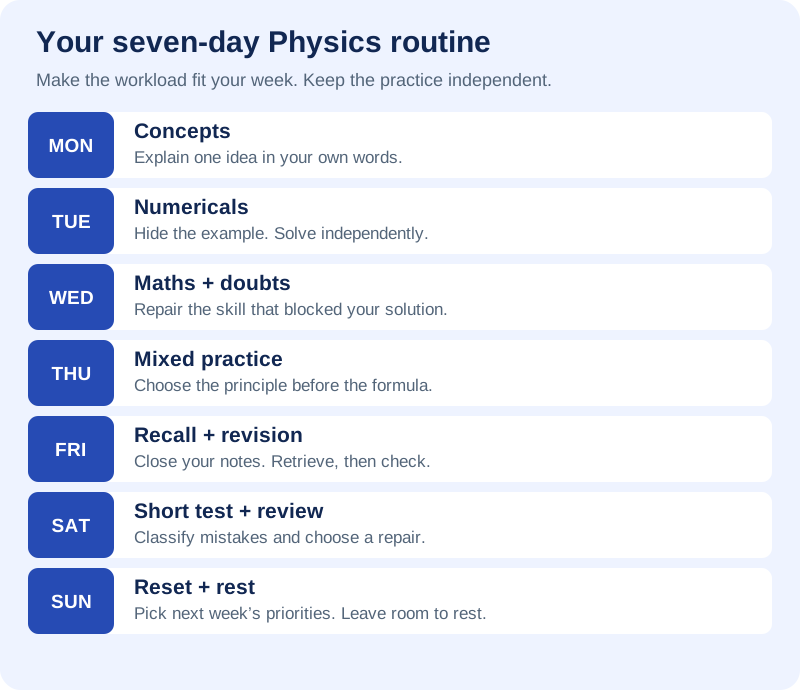
Start with a routine you can repeat
You sit down with your Physics notebook, read a few pages and watch a solved example. Everything seems clear—until you try a question on your own. If this sounds familiar, your next step is to give independent practice a regular place in your week.
A useful Class 11 Physics routine makes time for three activities: understanding concepts, solving numericals and returning to earlier learning. Spending the whole week on only one of these can leave gaps. Reading alone gives you too little practice making decisions; solving without reviewing can let the same mistakes continue.
The plan below is a suggested starting point, not a compulsory timetable. Try about 45–60 minutes on most days, adjusting around school, tuition, other subjects and rest. Choose one manageable part of the chapter currently being taught.
Monday: understand one small concept
Begin with your class notes and the relevant textbook section. Pick a specific target, such as displacement versus distance or how to resolve a vector. Avoid setting a vague goal such as ‘finish mechanics’.
Read carefully, then close the book and explain the idea aloud. Draw a diagram or give a simple example. Write down the meaning and units of each symbol in any formula, along with the conditions under which the formula applies.
Finish with two or three straightforward questions. If they expose a gap, mark the exact point of confusion. Your aim today is a clear foundation, not a high question count.
Tuesday: turn a worked example into independent practice
Study one worked example and ask why each step is needed. Then hide the solution and reproduce the reasoning on blank paper. If you cannot begin, return only to the first missing step rather than rereading the entire answer.
Attempt four to six similar questions independently. Before calculating, list the given quantities, identify the unknown and draw the situation where useful. Choose the governing principle before substituting numbers.
For motion with constant acceleration, for example, check that the assumption is justified and choose a positive direction. A negative velocity may simply describe direction; it does not automatically mean the calculation is wrong.
Wednesday: repair the supporting mathematics
Use today to practise the mathematical tool that caused difficulty yesterday. It might be rearranging an equation, handling powers of ten, resolving components or interpreting a graph.
Connect the tool to the Physics. On a velocity–time graph, slope represents acceleration, while signed area represents displacement. Explain the difference before attempting a calculation. Practise a few short examples and then return to the original Physics question.
Keep a short doubt list with specific questions. ‘Why did I choose the wrong component?’ is much easier to resolve than ‘I do not understand vectors’.
Thursday: mix question types
Attempt a small set in which the method is not announced in advance. Include a conceptual question, a graph or diagram question and several numericals from the part of the chapter you have studied.
Write one sentence explaining your choice of principle. After solving, check units, signs and whether the answer is physically reasonable. Do not judge the session only by how quickly you finish.
If you get stuck, make a genuine attempt first: redraw the situation, identify known quantities and consider a simpler case. Then use a small hint or ask a teacher. Copying a full solution leaves the original decision-making difficulty unresolved.
Friday: revise without looking first
Begin on a blank page. Write the key ideas, diagrams and formulas you remember from the week. Then open your notes and correct omissions or misunderstandings in a different colour.
Reattempt two questions you previously missed and one question from an earlier chapter. Keep the solutions closed until you have completed your attempt. Recognising an answer is different from being able to produce it.
For a derivation, practise the physical assumptions and logical steps as well as the algebra. If you forget a step, identify what connects the line before it to the line after it.
Saturday: take a short check and analyse it
Set yourself a short test using questions from material already studied. For example, allow 25–30 minutes for a manageable selection of conceptual and numerical questions. This is a personal progress check, not an official exam simulation.
After marking, classify each error: concept, choice of method, diagram or sign, calculation, or misread instruction. For each one, write a specific action. ‘Check whether acceleration is constant’ is more useful than ‘be careful’.
Record how many questions you could start independently, not just your final score. Bring attempted solutions to your teacher when the same difficulty appears repeatedly.
Sunday: keep it light and prepare the next week
Spend a short session reviewing the mistake list and selecting one or two priorities. Leave room for rest and your other subjects. A plan that requires exhausting catch-up sessions is unlikely to stay manageable.
If you missed a day, move its most important task to the next available slot. Avoid doubling every session or restarting the whole chapter. Keep up with current lessons while repairing one specific older gap at a time.
Choose next week’s target from what your work has shown. If diagrams are clear but equation selection is weak, make that your focus. If calculations are the problem, practise the relevant mathematics alongside Physics.
Measure progress through the decisions you can make
At the end of the week, ask: Can I explain the concept without reading? Can I choose a principle and begin a fresh question? Can I correct a previous mistake and explain why it happened? These answers help you decide what to practise next.
You can download chapter sheets from CBSE Practice Papers on www.physics.guru. For available exam-specific previous-year questions, use Competition Corner and review the solutions after submitting. Choose material suited to your current learning rather than attempting every resource at once.
If you need help building a workable routine or resolving recurring doubts, explore Physics classes with Sunil Sir through www.physics.guru, or contact Good Marks Classes, Sector 85, Gurgaon, on 8800 8800 28. Small-batch and online options are available.
A useful week does not need to be perfect. It needs a clear target, honest independent practice and a chance to learn from what went wrong.